
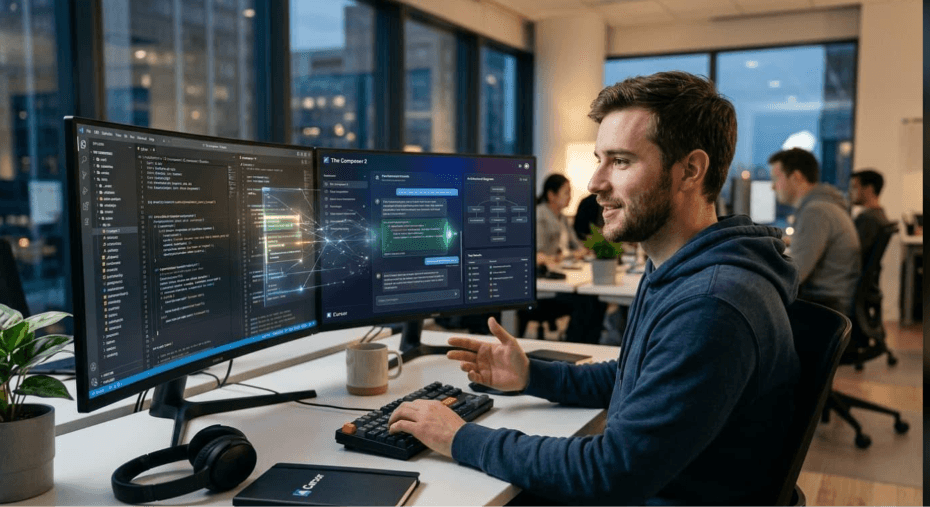
AI-Powered Software Development in 2026: How AI Agents Are Changing the Way Businesses Build Software
Artificial intelligence is transforming software development in 2026. What began as code completion and programming assistance is evolving into AI-powered systems capable of supporting planning, implementation, testing, and code review.
For businesses in the United States and Europe, this shift creates new opportunities to develop applications more efficiently. It also raises important questions about software quality, security, governance, and the role of experienced engineers.
Understanding these changes can help companies make better technology investments and prepare their development teams for the next generation of software engineering.
## AI Agents Are Becoming Part of the Development Lifecycle
Traditional AI coding assistants primarily help developers write or explain code. Agentic development tools go further by coordinating multiple steps of a software engineering task.
Depending on their capabilities and permissions, these systems can analyze requirements, suggest implementation plans, modify application code, generate tests, and propose changes for human review.
In May 2026, Gartner reported that enterprise AI coding agents were entering a new phase of expansion. The research highlighted a shift toward agentic workflows across the software development lifecycle.
Gartner also predicted that, by 2027, more than 65% of engineering teams using agentic coding would consider traditional integrated development environments optional.
This forecast reflects a potential transformation in how developers interact with software projects, although it does not mean that conventional development tools or human engineers will disappear.
Businesses Are Investing in AI-Powered Engineering
According to McKinsey's August 2026 State of AI report, approximately one in five surveyed organizations were scaling software coding agents.
The same research found that 32% of respondents said their organizations had decided against purchasing at least one software product or feature because they could build it internally using agentic coding tools.
This creates an important opportunity for custom software development.
Businesses may increasingly evaluate whether to purchase an existing platform, customize an available solution, or build software tailored to their operations.
AI-assisted engineering can make some internal development options more attractive, but the decision still depends on maintenance costs, integration requirements, security, and long-term business value.
Why Experienced Software Engineers Still Matter
AI can accelerate development tasks, but generating code is only one part of building reliable software.
Professional engineering teams remain responsible for:
- Translating business requirements into technical specifications.
- Designing scalable application architectures.
- Evaluating security vulnerabilities and data protection requirements.
- Integrating software with existing business systems.
- Reviewing AI-generated code and validating its behavior.
- Maintaining applications after deployment.
AI-generated code may contain logical errors, insecure dependencies, or implementations that fail to meet business requirements.
Human oversight remains essential, particularly for enterprise applications handling sensitive information or critical workflows.
How Companies Can Adopt AI in Software Development
Organizations interested in AI-assisted development should begin with clearly defined use cases rather than attempting to automate their entire engineering process immediately.
1. Identify High-Value Development Tasks
Start with activities such as automated testing, documentation, code analysis, or repetitive implementation work.
2. Establish Security and Governance Policies
Define which tools developers can use, what information can be shared with AI services, and how generated code must be reviewed.
3. Integrate AI Into Existing Workflows
AI tools should complement established version control, continuous integration, testing, and deployment processes.
4. Measure Real Business Outcomes
Evaluate development cycle times, defect rates, maintenance requirements, and delivery quality rather than measuring productivity only by the amount of code generated.
The Future of Custom Software Development
AI is changing the economics and workflows of software engineering, but successful projects will continue to depend on technical expertise and business understanding.
Companies that combine AI-assisted tools with experienced engineering teams may be better positioned to improve development efficiency while maintaining control over quality and security.
For businesses evaluating new applications, modernization projects, or AI integrations, the goal should be to use automation where it delivers measurable value.
Build Smarter Software with Devlync Tech
Devlync Tech provides custom software development, backend engineering, cloud solutions, and AI integration services for businesses in the United States and Europe.
Whether you're exploring AI-enabled applications or modernizing an existing software platform, our team can help you evaluate the technical requirements and development approach for your project.
Sources
- Gartner — *Enterprise AI Coding Agents*, May 20, 2026.
- McKinsey — *The State of AI in 2026: On the Road to ROI*, August 25, 2026.
- eu-LISA — *Generative AI in Software Development*, July 9, 2026.